
Improvement sounds straightforward until two people use the word for different changes. One might mean a small shift from a difficult starting point; another might mean reaching a personally important goal. A research result becomes more useful when we ask what question produced it, how the answers were classified, and what the comparison was designed to establish.
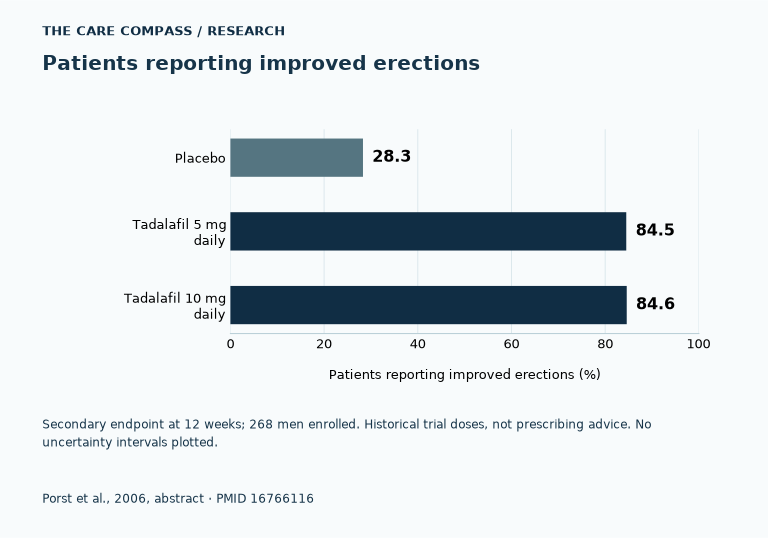
The accompanying chart provides a starting point for that exercise. We will examine the logic of the endpoint rather than use it as a personal forecast. Numerical examples below are clearly labeled illustrations, not additional study findings. The guide to mapping ED care helps keep these research questions connected with the clinical conversation and the arrangements surrounding it.
Trial chart and data
Download chart (PNG) · Download data (CSV) · Download vector (SVG)
| Study group | Reported value |
|---|---|
| Placebo | 28.3 |
| Tadalafil 5 mg daily | 84.5 |
| Tadalafil 10 mg daily | 84.6 |
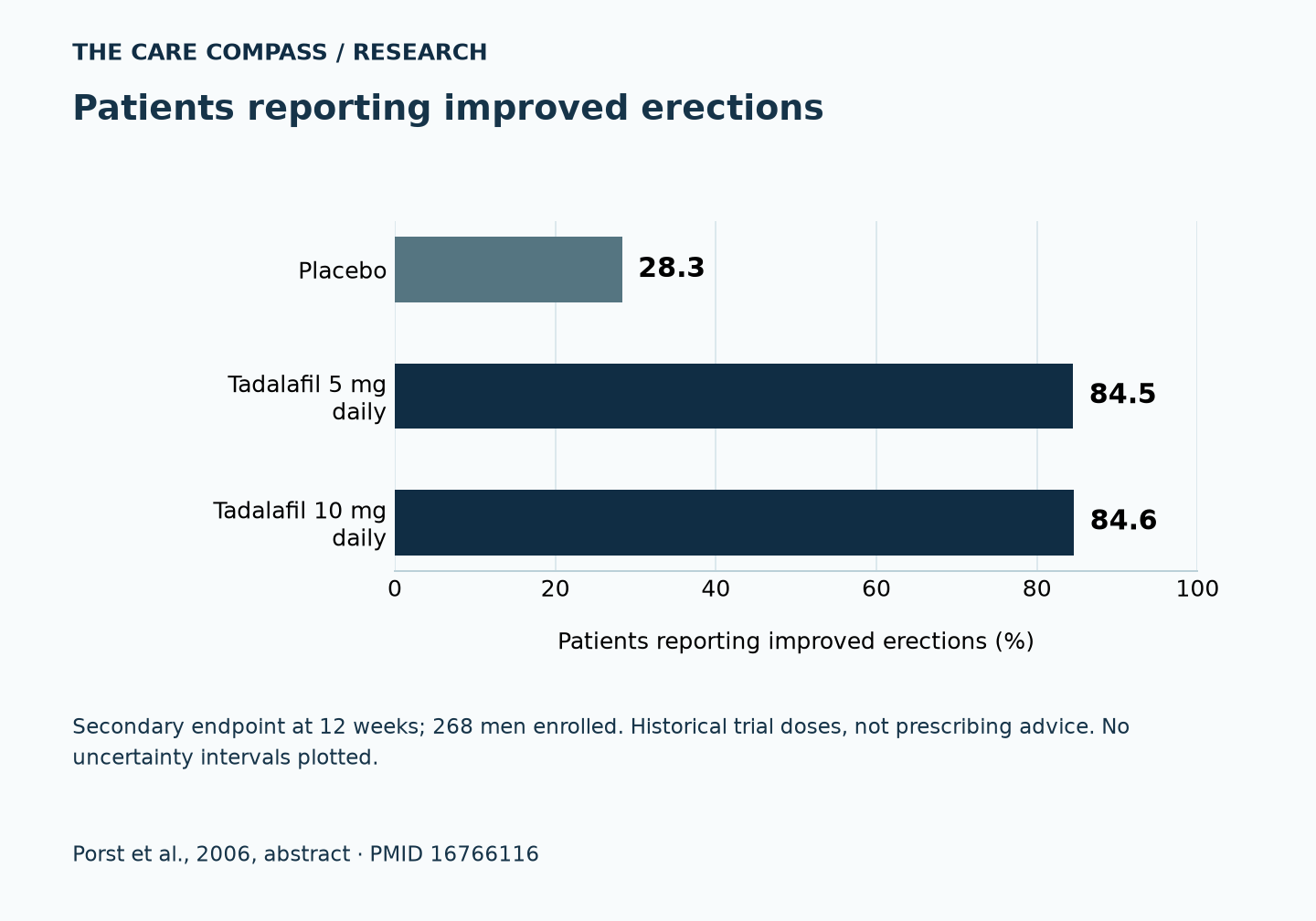
Secondary endpoint at 12 weeks; 268 men enrolled.
Historical trial doses, not prescribing advice. No uncertainty intervals plotted.
Read the response before interpreting the percentage
Porst randomized men with ED to daily oral tadalafil or placebo, double-blind. The chart shows a secondary endpoint. A percentage is the arithmetic summary of answers, but its meaning begins with the question that generated them. Before interpreting a tall bar, distinguish a report of improvement from the amount of improvement, the final level of function and whether a particular goal was reached. Those are related concepts, not interchangeable definitions.
A broad response can be meaningful precisely because it reflects a person’s overall judgment. Its compression also leaves details behind. Two people who select the same category may have experienced changes of different sizes or attached importance to different aspects of the experience. This does not make the response invalid. It means the response should be read alongside the question it was intended to answer. Our editorial interpretation is to use the result as evidence about a defined patient report, then ask which additional information would make it useful for the concern being evaluated. Replacing the response with a stronger word such as cure would change the claim.
Distinguish a category from the size of a change
A category groups experiences that satisfy a rule. A scale can describe differences within that group, depending on what its points measure. Consider a purely invented illustration in which improvement means a higher score than before. Moving from two to three and from two to eight would both qualify, despite very different changes. The example is about classification, not the questionnaire or scoring procedure used in this trial.
The reverse problem also matters: identical numerical changes may mean different things depending on the scale and the person’s priorities. A change in points should therefore keep its instrument attached, just as a percentage should keep its response definition attached. The table shows the distinct questions these summaries can address. Our sildenafil patient-log guide explores another unit, an event count. Its measurement lesson complements this one without creating a direct comparison between medicines. To compare interventions scientifically, the outcomes and study conditions would need to support the comparison; converting all results into large-looking numbers does not make them commensurable. Choosing a meaningful outcome begins before choosing how to display it.
| Summary | Question it can address | Question left open |
|---|---|---|
| Improvement category | Did the response meet the definition? | How large or important was the change? |
| Change on a defined scale | How far did the measured score move? | What does that movement mean to the person? |
| Final level | Where did the measurement end? | How far was that from the starting point? |
| Count during a period | How many events were recorded? | How many opportunities were available? |
Keep baseline, change and destination separate
A starting measurement supplies context for a later one. If two people end at the same level but begin at different levels, their changes differ. If their changes match but their starting levels differ, their destinations differ. These are simple relationships, yet they explain why a single favorable category cannot describe the whole course of an experience. The missing dimension may matter for interpreting what success would mean in practice.
An illustrative sketch makes the distinction concrete: movement from one to four and movement from six to nine both add three units. The example uses an imaginary scale with no clinical thresholds. It does not imply that either change has a particular medical meaning. That interpretation would require an actual instrument and evidence about its use. For a care discussion, the analogous question is what difficulty exists now and what change would matter. The guide to diabetes and erection concerns provides a route to discussing relevant clinical context. A broad trial result does not automatically become a separate estimate for a particular condition merely because that condition is part of someone’s history.
Use randomization to ask a causal question carefully
Randomization is a way to keep treatment assignment from simply following the preferences and expectations of participants or clinicians. Without it, differences between groups could reflect why people chose or received different treatments. A randomized design strengthens the interpretation of a comparison, while still leaving room for chance differences, departures from the plan and incomplete observation. The design is a foundation for reasoning, not a blanket guarantee about every later analysis.
Blinding addresses a different concern: knowledge of assignment can affect expectations, behavior or reporting. It does not guarantee that expectations vanish or that everyone remained unaware of assignment. Assessing how blinding worked would require appropriate study information. These distinctions become especially useful with a subjective response. A patient report can be valuable without being identical to a laboratory measurement, and attention to how it was collected is part of evaluating that value. Rather than dismissing subjective evidence or treating it as unquestionable, ask how the comparison reduced alternative explanations. The answer should follow the documented design, not assumptions about procedures that are unavailable for inspection.
Let the placebo group define the comparison, not a story
A placebo comparison helps separate the outcome observed under active treatment from what was observed under the comparison conditions. It does not tell us why every person in either group reported a change. Changes can have multiple possible explanations, and assigning a specific psychological or biological mechanism requires evidence beyond the percentage itself. In particular, describing a comparison-group response as imaginary would dismiss the reported experience without examining it.
The scientific question is about the contrast between groups within the study, rather than whether one group changed from its own starting point. Before-and-after improvement alone leaves open what would have happened over the same period without the active intervention. That is why a favorable-looking percentage benefits from a comparator. It is also why the result should not be detached from the conditions in which both groups were observed. To discuss broader clinical considerations, heart health and ED belongs alongside the research conversation. The comparator addresses a treatment question; it cannot independently establish the cause of an individual concern or replace assessment of cardiovascular suitability.
Do not turn neighboring bars into an equivalence claim
Two displayed percentages can look nearly identical while the evidence needed to show equivalence remains absent. Equality of rounded numbers, similarity of point estimates and a formal equivalence conclusion are different propositions. An equivalence analysis needs a justified margin for how much difference would count as acceptably small, along with an analysis capable of addressing that margin. Visual resemblance does not supply those ingredients.
Likewise, finding evidence that each active group differs from placebo would not, by itself, answer whether the active groups differ from one another. Each comparison has its own question and uncertainty. A reader should avoid selecting a dose by inspecting bar height, or assuming that a slightly taller bar demonstrates a meaningful advantage. The chart is not a dosing calculator. Its display also omits uncertainty intervals; that does not establish that the full paper contained none. Without the appropriate analysis, manufacturing intervals from guessed arm counts would produce an appearance of rigor unsupported by the available information. The table separates the claims that are often collapsed into a quick visual judgment.
| Proposed claim | What would need evaluation | Why a visual comparison is insufficient |
|---|---|---|
| One group differs from placebo | That specific contrast and its uncertainty | A percentage alone omits uncertainty |
| Active groups differ from each other | A direct comparison of those groups | Separate placebo comparisons answer another question |
| Active groups are equivalent | A justified equivalence margin and suitable analysis | Similar point estimates do not establish a margin |
| A regimen fits one person | Current labeling and clinical assessment | Group estimates do not screen individual suitability |
Place one outcome within the larger research question
Primary measures included erectile-function scores, encounter-diary outcomes and tolerability. A study can examine several dimensions because no single measurement captures every relevant consequence of treatment. Choosing one outcome for a graphic is an editorial decision about explanation. It should not erase the existence of other outcomes or imply that the highlighted response was the only question the research set out to answer.
Endpoint hierarchy helps readers understand which questions organized the study and which supplied additional information. Interpreting several outcomes also raises questions about the analysis plan: which comparisons were specified in advance, how uncertainty was assessed, and how multiple tests were handled. We should not invent those procedures from a short report. Nor should an appealing secondary outcome be promoted into a universal conclusion merely because its wording is easy to understand. The constructive approach is to say what the displayed measure contributes and identify the other evidence needed for a broader judgment. Benefit, tolerability and clinical suitability are different dimensions. A strong result on one dimension cannot silently fill every empty cell on the others.
Distinguish a follow-up result from a continuous history
An endpoint is a defined time at which an outcome is evaluated. It does not necessarily describe what happened on every preceding day. To understand a trajectory, one would need repeated observations and the rules used to summarize them. An endpoint alone cannot identify when improvement began, whether it was steady, or whether every person followed the same course. Those are additional questions rather than details to infer from a final percentage.
The denominator also needs attention. The number enrolled in a study and the number contributing to a particular endpoint are conceptually different. To evaluate incomplete responses, a reader would want participant flow, reasons for missing observations and the analysis method. Missingness connected to the outcome could affect interpretation, but its direction should not be guessed. A sensitivity analysis asks whether the conclusion changes under plausible alternative assumptions; it does not create observations that were never collected. Similar care applies after follow-up ends. Projecting a result indefinitely assumes persistence. A finite research window can support a useful finding while leaving longer-term durability, discontinuation patterns and later experiences as separate research questions. An additional observation would answer an additional question; it should not be silently supplied by extrapolation.
Keep the historical arms beside current safety information
Current CIALIS labeling describes daily ED treatment at 2.5 mg, potentially increased to 5 mg; the chart’s 10 mg daily research arm is historical. This is prescribing-information context, not a personal regimen. Nitrates and guanylate cyclase stimulators including riociguat are contraindicated. Cardiovascular suitability, other medicines and kidney or liver conditions need assessment. Recognized adverse effects include headache, indigestion, back pain and muscle pain. An erection lasting over four hours requires emergency care. Stop treatment and obtain prompt care for sudden vision loss or hearing decrease or loss. Chest pain during sex requires stopping activity and immediate attention.
Benefit estimates cannot perform that assessment. Nor does an ingredient name establish that a different formulation shares the evidence. FDA states that compounded medicines are not FDA-approved and do not undergo premarket review for safety, effectiveness and quality, although they may meet legitimate medical needs. Our application is to verify the actual product and its prescribing and dispensing arrangements. The Ro Daily Tadalafil review is a place to examine documentary terms, without transferring the study’s outcome to that service.
Turn a broad response into a focused care question
Lilly ICOS funded the study; Lilly provided writing and editorial support. Knowing the sponsor’s role helps readers judge how the research was produced. It does not settle the result’s validity by itself. Methods, measurement, comparison and reporting still need scrutiny. The same discipline applies when moving from the paper to care: distinguish the evidence about a treatment from evidence about the service through which someone might seek it.
Our editorial interpretation is to begin with a concrete concern and a definition of meaningful change, then ask what clinical information is needed to assess suitability and review progress. The guide to preparing for remote care can help organize that conversation. If comparing arrangements, the Hims Tadalafil review invites checking documentary terms rather than assuming a research result predicts a provider’s performance. A useful follow-up question is how benefit and unwanted effects would each be assessed. This keeps the patient’s experience central while avoiding a common shortcut: treating selection of a favorable response category as proof that every relevant treatment goal has been met.
Questions about the evidence
Does reporting improvement mean that the original problem disappeared?
An improvement category and complete resolution are different definitions. Without the exact response rule and supporting measurements, one should not replace a broad positive response with a stronger conclusion. A care conversation can separately examine the amount of change and whether the concern that matters remains.
Can the bar heights identify the best daily dose?
No. Reading a group estimate is not selecting an individual regimen. Nearness between estimates does not establish equivalence, and a small visual difference does not establish a meaningful advantage. Current prescribing information and clinical assessment address a separate decision that the display cannot make.
Why retain a patient report if it compresses experience?
Compression is what makes a summary possible. A broad judgment can address an aspect of experience that a narrower measurement misses. Its usefulness depends on preserving the definition and recognizing what detail was lost, rather than asking the category to answer every question about function or satisfaction.
Can these findings be ranked against an event-count trial?
Not simply by comparing the displayed numbers. A patient category and an event count use different units and answer different questions. A valid treatment comparison needs compatible outcomes and study conditions, or an appropriate comparative analysis. Rescaling the figures does not supply that missing foundation.
What would make the evidence more useful at an appointment?
Describe the current difficulty, the change that would matter and any uncertainties about suitability or unwanted effects. Then ask how those issues would be assessed. This converts a broad research result into focused questions while leaving diagnosis, treatment selection and follow-up planning with the clinician.
Editorial assessment
A patient-reported category is useful when its meaning remains visible. Read the comparison, starting context, follow-up and uncertainty before turning the result into an expectation. Similar percentages cannot determine a regimen, and a positive response does not resolve every question about benefit or safety. The practical value of this evidence is a better discussion: identify what improvement would mean for the concern at hand, what information is missing, and how a clinician would judge both suitability and progress.
Research access and limitations
We reviewed the indexed abstract and Acknowledgments; the full paper and complete conflict declarations were unavailable. Original methodological illustrations are not participant data. Current labeling and FDA guidance are separate evidence sources. The chart omits uncertainty intervals and does not establish equivalence, personal dosing or provider outcomes.
Follow the sources
Scientific sources carry their own access dates below. Existing medical and provider records retain their original October 6 or 7 checks. Medical resources supply general context; provider pages describe advertised terms. A citation is not an endorsement of this publication or a service.
- Porst et al. (2006): daily tadalafil trialAbstract and indexed primary excerpts · Checked 2026-10-23Indexed funding disclosure
- Cialis (tadalafil) prescribing informationOfficial prescribing information; relevant sections reviewed · Checked 2026-10-23
- Goldstein et al. (1998): oral sildenafil trialAbstract and indexed primary excerpts · Checked 2026-10-23Indexed funding disclosure
- Understanding the risks of compounded drugsFDA public guidance · Checked 2026-10-23